

3Q 2026 Investment Letter
October 1, 2026
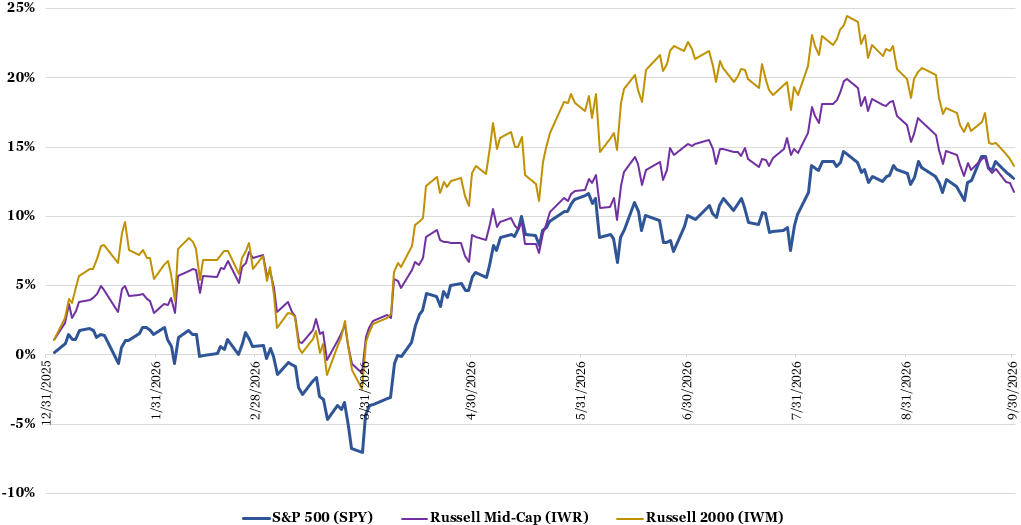
The third quarter built on the considerable gains of the second quarter, with the S&P 500 (SPY) advancing another 2.4%, bringing its year-to-date return to 12.7%. Technology, communication services, and energy sectors, and mega caps broadly, were the outperformers. Conversely, economically sensitive and interest rate sensitive areas like industrials, real estate, and consumer discretionary struggled mightily. Mid-cap and small-cap stocks similarly underperformed after entering the quarter with substantial year-to-date gains.
Figure 1: The Largest Companies Propped Up the Stock Market in the Third Quarter
Source: Koyfin (inclusive of dividends)
The reescalation of the Iran War was a major development. Brent crude bounced back to around $100 per barrel, causing consumer pain at the pump. Perhaps more impactful, diesel prices reached $6.38 per gallon during the week of September 28th, up 39% from early July and 70% from year ago levels because of constrained refinery output and lost supply from the Middle East, Russia and China. Diesel prices can have major impacts on broader inflation because trucks, railroads, agriculture, construction and industrial equipment all depend heavily on diesel fuel. The higher costs of production and transportation eventually flow through to higher costs of goods.
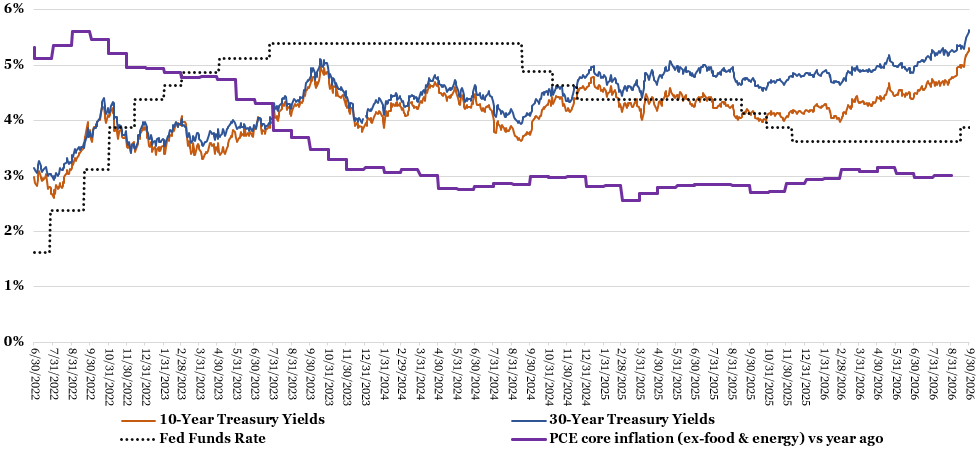
The ongoing Iran War has increasingly become an issue for the Federal Reserve. At its September 16th meeting, the Fed raised the federal funds rate by 0.25% to a range of 3.75%-4.00%, its first hike in over three years, as it tries to throttle inflation back to its 2% target. Further Fed increases are likely forthcoming because the Fed rarely stops hiking after the first rate increase, and already the Fed is penciling in an additional rate hike later this year. Concerns around inflation, the growing federal budget deficit, and strong competing demand for bonds from the artificial intelligence (AI) buildout caused the influential 10-year U.S. Treasury yield to climb to 5.3%, its highest level since 2007.
Figure 2: Sharp Rise in Bond Yields Late in the Third Quarter
Sources: St. Louis Fed/Board of Governors of the Federal Reserve System. https://fred.stlouisfed.org/series/DGS10 (10-year US Treasury yield). https://fred.stlouisfed.org/series/DGS30 (30-year US Treasury yield) https://fred.stlouisfed.org/series/PCEPILFE (PCE inflation ex-food & energy). Forbes Advisor. https://www.forbes.com/advisor/investing/fed-funds-rate-history/ (Fed Funds rate).
Perhaps the most notable characteristic of the stock market during the quarter was its ability to withstand the rapid rise in Treasury yields. Ordinarily, a yield advance that swift would significantly pressure stock valuations, particularly those of growth companies. Yet the S&P 500 remained near record highs. Driving stock market resiliency is robust earnings growth. Adjusted for unrealized investment gains, second-quarter S&P 500 earnings increased 33% from year ago levels. Current estimates call for continued strong increases in S&P 500 earnings during the third and fourth quarters of roughly 30%.
The AI, or “superintelligence” as President Donald Trump would prefer to call it, investment theme is largely responsible for the strong earnings. AI spending has shown few signs of slowing with the big four hyperscalers -- Alphabet (GOOG), Amazon (AMZN), Microsoft (MSFT), and Meta (META) -- collectively increasing their 2026 capital expenditure expectations by another 5% to $710 billion, an 80% increase from 2025. Importantly, Alphabet, Amazon, and Microsoft each reported meaningful acceleration in their cloud revenue growth rates, which defers spending sustainability concerns.
The list of AI beneficiaries has spread beyond the data centers, semiconductors, networking equipment, power equipment, memory and other components required to build AI infrastructure. We are amidst an explosion in AI agents designed to carry out specific tasks with limited human involvement. Meta’s Muse personal AI agent launch on September 8th is likely the first of many competing offerings.
Several of our holdings stand to benefit from the explosive growth in agentic AI. AMD (AMD) benefits from agentic AI because agents require a greater number and complexity of inference calls per user task, driving demand for AMD’s Instinct GPUs, EPYC CPUs, and supporting data-center infrastructure. Datadog (DDOG) benefits from agentic AI because increasingly complex, autonomous AI applications create more services, model calls, dependencies, and failures that enterprises need Datadog to monitor, troubleshoot, and secure. Finally, CrowdStrike (CRWD) benefits from agentic AI because autonomous agents dramatically expand the number of machine identities, actions, and attack paths that enterprises must continuously monitor, authorize, and secure.
Market Outlook
The sustainability of the stock market advance will likely depend on the tug of war between strong corporate earnings growth and higher bond yields. On the former, as long as the hyperscalers and frontier AI model companies Anthropic, OpenAI, and xAI have the willingness (strong anticipated returns) and ability (access to funding, new regulations do not hinder growth, data center permitting issues can be overcome) to continue to spend ever greater sums on AI infrastructure, then all the ‘picks and shovels’ supplier stocks ought to continue to perform well. Further, as AI capabilities advance and businesses deploy more AI, they ought to gain meaningful efficiencies (at the eventual expense of employees?) over time, supporting company margins and earnings.
Bond yields are a big wild card. The impossible-to-predict evolution of the Iran War and resulting energy price impacts figure prominently into inflation, and ultimately bond yields. If yields keep rising, there could be large negative effects on the AI buildout, much of which is debt-funded, and the overall economy. Further, the bottom half of the K-shaped economy is already struggling with cost-of-living issues, and rising borrowing costs could serve to constrain low to medium income household spending further.
The fourth quarter will include the November 3rd midterm elections, when all 435 seats in the House of Representatives and approximately one-third of the Senate will be contested. The outcome will determine control of Congress for the final two years of Trump’s second term and will influence the intermediate-term outlook for taxes, spending and AI regulation. The stock market may not respond well if the Democrats win the House and Senate, to which Kalshi places odds at 62%.
As I continue to emphasize, successfully timing the stock market is extraordinarily difficult. The first nine months of 2026 illustrate this well. If at the beginning of the year we were told the U.S. would start a major regional conflict in the Middle East that caused oil prices to spike above $100/barrel, the Fed started to raise rates instead of cut them, and 10-year bond yields surged to 19-year highs, most would have expected a tough year for the stock market. Instead, the bulls have stampeded largely unabated. Although risks undoubtedly remain, I continue to believe that investors are best served by ignoring the near-term noise and adhering to a long-term asset allocation that aligns with their individual return objectives, risk tolerance, and investment horizon.
Client Positioning
I take a long-term view that focuses on compounding returns in a tax-efficient manner. I allocate the bulk of my clients’ equity exposure to “quality growth” companies that possess durable competitive advantages, above-average long-term growth prospects, high levels of profitability and free cash flows, and prudent levels of debt. I generally take a “pruning the weeds and nurturing the flowers” approach of selling stocks that violate my investment thesis and retaining stocks of companies with solid fundamentals. I believe this investment philosophy affords my clients the best shot of generating maximum after-tax, risk-adjusted returns compounded over the long run.
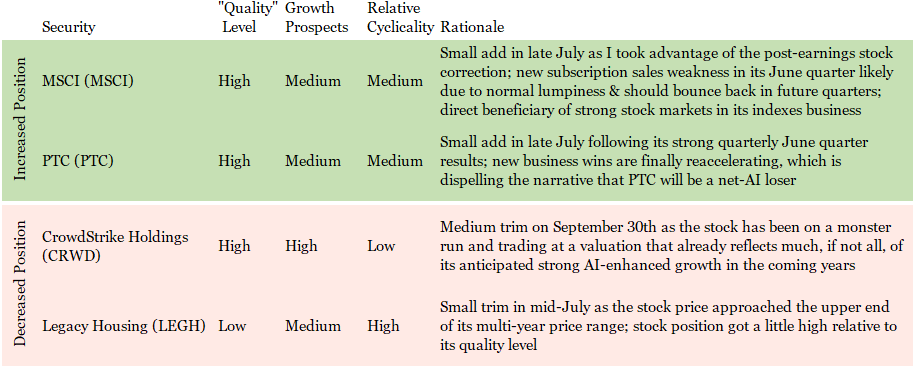
Portfolio activity was relatively light during the third quarter and involved trimming two positions into strength. The first trim was to manufactured housing company Legacy Housing (LEGH) in mid-July at around $27.36 per share. I took a modest trim from a medium-sized weighting as the rare (relative to what I typically own) value-oriented stock recovered closer to what I consider its fair market value.
Then on September 30th I took another moderate trim of cybersecurity company CrowdStrike Holdings (CRWD) at about $265 per share. The stock has been on a tear this year, up 126%, which pushed its average weighting across client portfolios back to 5%. Although the company is ideally positioned for the growing cyber threats in an increasingly agentic AI world, I must maintain some sell discipline given its valuation reached extreme levels of 166x next fiscal year’s expected earnings.
The Legacy Housing proceeds mostly went to slightly increase our positions in MSCI (MSCI) and PTC (PTC). Meanwhile, the CrowdStrike proceeds mostly went to increase clients’ fixed income allocations as the large increase in yields in the quarter increased the relative attractiveness of the asset class versus stocks. Finally, I tax-loss harvested shares of CoStar Group (CSGP) across clients’ taxable (non-retirement) accounts by repurchasing shares 13% below where they were sold over 30 days prior.
Figure 3: Portfolio Changes in Majority of Client Accounts in 3Q 2026
Source: Glass Lake Wealth Management
I continue to closely monitor our numerous positions across the AI infrastructure space. As bullish as I am on the near-, medium-, and long-term fundamentals of the companies positively exposed to this generational boom, I am mindful that expectations are sufficiently high such that any inkling of AI funding shortfalls, reduced AI capital expenditures, or disappointing monetization of AI could lead to a dramatic, even if temporary, correction in affected names. I will look for opportunities to trim into strength, and add on notable weakness, while being mindful of each client’s tax situation.
If interest rates continue to march higher, I will strongly consider redeploying cash from trimmed positions into fixed income. Fixed income is making a good case for increased allocation with yields greater than 4.5% on safe short- to intermediate-term government debt, and higher levels than that as you move along the credit risk spectrum. Still, I wish to abstain from long duration holdings (duration is a measure of a bond price’s sensitivity to changes in interest rates; when interest rates rise, bond prices fall) because of the United States’ challenging fiscal situation and rising long-term government bond yields globally.
Have a happy, healthy, and wealthy fall season!
Sincerely,

Jim Krapfel, CFA, CFP
Founder/President
Glass Lake Wealth Management, LLC
glasslakewealth.com
608-347-5558
Disclaimer
Advisory services are offered by Glass Lake Wealth Management LLC, a Registered Investment Advisor in Illinois and North Carolina. Glass Lake is an investments-oriented boutique that offers a wide spectrum of wealth management advice. Visit glasslakewealth.com for more information.
This investment letter expresses the views of the author as of the date indicated and such views are subject to change without notice. Glass Lake has no duty or obligation to update the information contained herein. Further, Glass Lake makes no representation, and it should not be assumed, that past investment performance is an indication of future results. Moreover, whenever there is the potential for profit there is also the possibility of loss.
This investment letter is being made available for educational purposes only and should not be used for any other purpose. The information contained herein does not constitute and should not be construed as an offering of advisory, legal, or accounting services or an offer to sell or solicitation to buy any securities or related financial instruments in any jurisdiction. Certain information contained herein concerning economic trends or market statistics is based on or derived from information provided by independent third-party sources. Glass Lake Wealth Management believes that the sources from which such information has been obtained are reliable; however, it cannot guarantee the accuracy of such information and has not independently verified the accuracy or completeness of such information or the assumptions in which such information is based.